24-bit / 50 kS·s⁻¹
Per-channel IEPE acquisition — bearing energy visible down to ~12 RPM.

Deployment · wired
Conceptual architecture comparison. Validate sampling, protocol, safety, lifecycle, and cloud requirements against the engineered configuration.
 Official ecosystem hardware
Every SensorDataFabrics node runs on a standard Beckhoff industrial PC — CX9240 to C6030 — with TwinCAT and EtherCAT underneath. If we disappeared tomorrow, your hardware, spares and support contracts would still come from a global automation vendor you can already buy from.
Full-rate, uninterrupted signal and deterministic control — the deployment for critical rotating assets.
24-bit / 50 kS·s⁻¹
Per-channel IEPE acquisition — bearing energy visible down to ~12 RPM.
< 1 s
Local reaction on relays, tower lights and switches. No cloud round trip.
10× faster install
EtherCAT daisy-chains machine to machine on one Ethernet cable.
Continuous
Uninterrupted streaming and logging, not duty-cycled snapshots.
From accelerometer to plant system, on hardware you own.
Industrial accelerometers, including extreme-temperature variants from −270 °C to +800 °C.
One acquisition channel per sensor — the reason wired costs more per point, and why it sees more.
Sub-microsecond Distributed Clock sync, up to 65,535 nodes, daisy-chained across machines.
Linux host running alarms, DSP, AI and egress — plus FSoE 'Black Channel' SIL 3 safety when required.
The autoencoder watches continuously and flags the anomaly; the post-processing suite is how you diagnose it — on months of full-rate 24-bit captures.
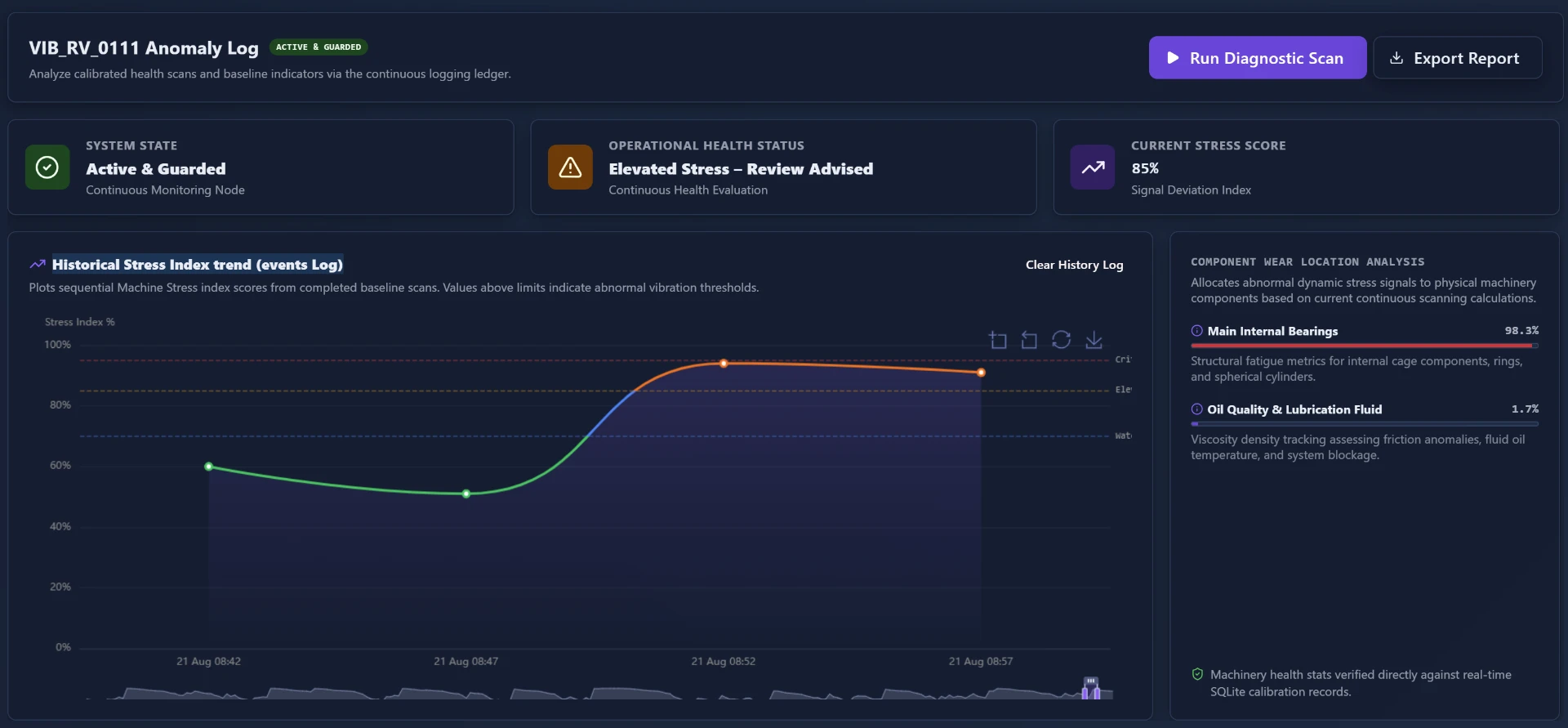
Continuous 24-bit streaming means months of full-rate captures are on the node — compression-first storage keeps the evidence ready when the AI points at it.
The autoencoder learns each machine's normal from continuous 24-bit / 50 kS·s⁻¹ streams — more data, better model, no expert spectra setup.
Stress Index climbs through Watch → Warning → Danger. Relays, tower lights and switches respond locally in under a second — no cloud round trip.
Open the full-rate captures around the event and run the post-processing that answers why — months of history, still on the node.
Post-processing toolkit — on demand, on the recorded data
FFT spectrum
harmonics, BPFO / BPFI lines
STFT waterfall
how the spectrum evolved
Power spectral density
broadband energy
Demodulation
envelope, early bearing defects
Cepstrum
sideband families, gear mesh
Spectral kurtosis
where the impulsiveness lives
Time domain
the raw waveform itself
Core services ship on every node. DSP and AI are add-ons that trade sensor capacity for intelligence.
RMS, Peak and Kurtosis computed continuously against ISO 10816-3 bands, driving physical outputs in under a second.
Full-rate FFT, STFT waterfalls, power density, envelope demodulation, cepstrum and spectral kurtosis on raw 24-bit captures.
An autoencoder learns each machine's normal and returns a 0–100 Machine Stress Index — trained and scored on the IPC itself.
Local time-series database per node. Buffers through outages, then forwards over OPC UA, MQTT, Modbus TCP or HTTPS.
HTTPS web HMI with Admin/Operator RBAC, edge health, live logs, and offline update with one-click rollback.
Optional cloud aggregation across sites. Switch it off and the edge keeps running.
One wired 24-bit channel costs roughly two wireless sensors' worth of compute. Each add-on trims capacity, not features.
with DSP + AI metrics only
| IPC | Metrics only | DSP + AI | Role |
|---|---|---|---|
| CX9240 | 24 | 14 | Compact DIN-rail embedded PC |
| C6015 | 48 | 29 | Ultra-compact industrial PC |
| C6025 | 72 | 43 | Modular industrial PC |
| C6030 | 96 | 57 | High-performance industrial PC |
Wired channels need a 24-bit / 50 kS·s⁻¹ acquisition card each — but EtherCAT daisy-chaining usually takes most of that back in cabling and labour.
EtherCAT millisecond control where you need wires. LoRaWAN miles of range where you don't.